![[Home]](images/flag.home.png)
![[Swedish]](images/flag.sweden.png)
![[Finnish]](images/flag.finland.png)
![[English]](images/flag.uk.png)
![[Russian]](images/flag.russianfederation.png)
![[German]](images/flag.germany.png)
![[French]](images/flag.france.png)
![[Spanish]](images/flag.spain.png)
![[Portuguese]](images/flag.portugal.png)
![[Italian]](images/flag.italy.png)
![[Hebrew]](images/flag.israel.png)
![[Arabic]](images/flag.arableague.png)
![[Persian]](images/flag.iran.png)
![[Urdu]](images/flag.pakistan.png)
![[Vietnamese]](images/flag.vietnam.png)
![[Mandarin]](images/flag.china.png)
![[Japanese]](images/flag.japan.png)
![[Indonesian]](images/flag.indonesia.png)

![[Program description]](images/csb_03.png)
![[Admission and requirements]](images/csb_04.png)
![[Career opportunities]](images/csb_11.png)

![[KTH]](images/csb_07.png)
![[Curriculum outline]](images/csb_09.png)
![[Virtual tour]](images/csb_10.png)
![[Theses and projects]](images/csb_05.png)
![[Faculty]](images/csb_12.png)
![[Glossary]](images/csb_13.png)
![[News]](images/csb_14.png)


KTH Computational Biology was created in 2005 to strengthen the KTH research profile in Computational Biology and related disciplines. The Department has three full professors and six lectures/junior lectures. The Department staff is in charge of most of the curriculum of the first year of the Master program, as well as coordinates two of the three specializations in the second year.
The Stockholm School of Entrepreneurship and the KTH School of Industrial Engineering and Management coordinates the third specialization. Key courses in the second year are offered by KTH School of Biotechnology. In addition, students in the second year can choose a wide selection of advanced courses offered by other Departments of KTH School of Computer Science and Communication.
 |
Lars Arvestad is Assistant Professor in Computer Science, teaching courses in programming concepts and Bioinformatics. His research interests are in computational methods for understanding molecular evolution and other areas of molecular biology. After his PhD at KTH, he worked in the pharmaceutical industry and the Karolinska Institutet before returning to KTH by joining the Stockholm Bioinformatics Center. |
|
| |
||
 |
Erik Aurell is is Professor at KTH and heads the Computational
Biological Physics research group at the department of Computational
Biology. His research focus is on gene regulation, and on design and
models of distributed systems in dynamic environments. He was co-organizer
of the Third International Conference on Systems Biology (ICSB 2002,
Stockholm).
|
|
| |
||
 |
Terrence Brown is currently serving on the SSES faculty as Course Director for the introductory venture creation courses Ideation and Planning. He is the former Dean of SSES and Program Director for the Scandinavian International Management Institute in Copenhagen. He holds an MBA in Entrepreneurial Management from the Wharton School of the University of Pennsylvania, an MBA in Organisational Management and a Doctorate in Entrepreneurship and Corporate Strategy from Rutgers University. He has published in various academic journals and is the Founding Editor in Chief of the International Journal of Entrepreneurial Venturing. He has also lectured throughout North America and Europe. |
|
| |
||
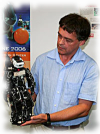 |
Örjan Ekeberg is Associate Professor in Computer Science since
1996. His research focus is on simulation models and computational
techniques for studying the interaction between neuronal circuits and
musculo-skeletal mechanics in the context of animal movement control.
|
|
| |
||
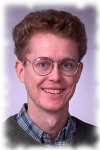 |
Erik Fransén is the Director of the Master Programme in Computational and Systems Biology as of August 2008. He is associate Professor in Computer Science at KTH and has been a post doctoral fellow at the Department of Psychology at Harvard University in 1997-1998. His research includes studies on the ionic basis of cellular and network excitability and of working memory using biophysical modeling and simulation. He gives courses in modeling of biological systems and in artificial neural networks and related mashine learning techniques. |
|
| |
||
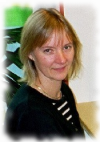 |
Jeanette Hellgren Kotaleski has a M.S. in Medical Sciences from Umeå University, a M.S. in engineering Physics from Royal Institute of Technology, and a PhD in computer science on work focusing on modeling bursting mechanisms and coordination in motor systems. From 1999 to 2001 she was a postdoc at the Krasnow Institute, VA, USA, modeling biochemical pathways underlying classical conditioning. After returning to Sweden, she is now an associative professor at School of Computer Science and Communication, Royal Institute of Technology. Her main research interests cover modeling of motor systems, including studying the dynamics in intracellular signaling networks involved in learning and synaptic plasticity. |
|
| |
||
 |
Alexander Kozlov received his Diploma in Radiophysics and PhD in Physics and Mathematics from the University of Nizhny Novgorod, Russia, in 1989 and 1995, respectively. He is a research fellow at the Department of Neurophysiology, Karolinska Institute, and at the Computational Biology and Neurocomputing, Royal Institute of Technology, Stockholm. His research includes dynamics of locomotor nervous systems, abstract and realistic neuron modeling and large-scale simulations. |
|
| |
||
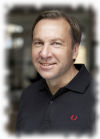 |
Jens Lagergren is Professor at KTH and heads the CBB research group at the Department of Computational Biology. He is also the Director of PhD studies at KTH School of Computer Science and Communication. His main interest are comparative genomics, gene regulation, and computational cancer research. He has an extensive international network and is a frequent program committee member of high profile bioinformatics and computational biology conferences. |
|
| |
||
 |
Anders Lansner is Professor in Computer science at Stockholm University and heads the CBN (Computational biology and Neurocomputing) research group at the Department of Computational Biology. His main interest is computational neuroscience and brain-inspired computation. He leads the computational neuroscience methodology platform at SBI (Stockholm Brain Institute) and the Swedish INCF-node in Neuroinformatics, and is currently partner of two European research consortia focused on theoretical and computational brain science. He has supervised more than ten PhD students in computer science with specialization towards computational neuroscience. |
