Forces, Fixpoints and the Meaning of Life
Dilian Gurov
I have several ideas that may not seem very related at first, but form a fascinating picture.
1. Repeated Transformations
A great many real world phenomena have a repeating nature, or can be seen
as the result of continuous or repetitive application of some force on
material objects. The result of such physical transformations can vary
considerably. Wind and rain cause stones to break into smaller pieces
and eventually become sand, which is stable to these forces. This
stable state of affairs can be seen as a fixpoint
of the transformation: further application of the force does not change
the state. Another common outcome is a different form of stabilization
where the system oscillates between the same set of states, as for
example a pendulum. And yet another possible outcome is chaos
in systems in which small causes can have large effects, so that
certain patterns of behaviour can be observed but not precisely
predicted.
A typical example of a chaotic system is weather, which is known to be
principally unpredictable for more than, say, four days ahead.
2. The Logistic Map
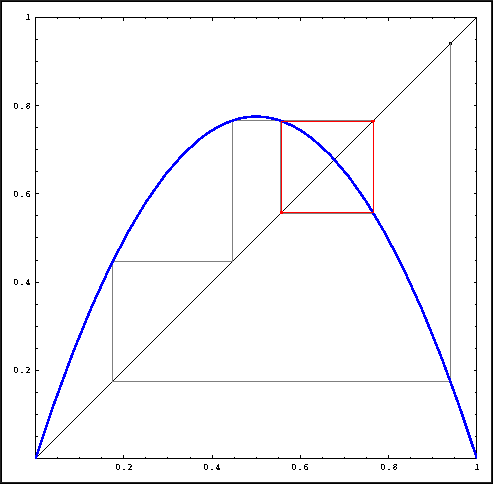
There is a very simple mathematical function that illustrates
fixpoints, oscillatory behaviour and chaotic behaviour in a visual and
intuitive manner, called the logistic map. It is defined as f(x) = ax(1-x). By choosing different values for the coefficient a and the initial value of the parameter x we obtain different behaviours.
Here is a
web link to an interactive Java applet, which allows the user to set
a and
x.
3. Zeno's Paradox of Achilles and the Tortoise, or How to Compute Fixpoints
A rather unexpected place to
find the foundational iterative construction of computing a fixpoint
is the ancient Greek tale of Achilles and the tortoise by the Greek
philosopher Zeno. The story goes roughly as follows.
The Tortoise challenged Achilles to a race,
claiming that he would win as long as Achilles gave him a small head
start. Achilles laughed at this, for of course he was a mighty warrior
and swift of foot, whereas the Tortoise was heavy and slow.
 “How big a head start do you need?” he asked the Tortoise with a smile.
“Ten meters,” the latter replied.
Achilles
laughed louder than ever. “You will surely lose, my friend, in that
case,” he told the Tortoise, “but let us race, if you wish it.”
“On the contrary,” said the Tortoise, “I will win, and I can prove it to you by a simple argument.”
“Go
on then,” Achilles replied, with less confidence than he felt before.
He knew he was the superior athlete, but he also knew the Tortoise had
the sharper wits, and he had lost many a bewildering argument with him
before this.
“Suppose,”
began the Tortoise, “that you give me a 10-meter head start. Would you
say that you could cover that 10 meters between us very quickly?”
“Very quickly,” Achilles affirmed.
“And in that time, how far should I have gone, do you think?”
“Perhaps a meter – no more,” said Achilles after a moment's thought.
“Very well,” replied the Tortoise, “so now there is a meter between us. And you would catch up that distance very quickly?”
“Very quickly indeed!”
“And yet, in that time I shall have gone a little way farther, so that now you must catch that distance up, yes?”
“Ye-es,” said Achilles slowly.
“And
while you are doing so, I shall have gone a little way farther, so that
you must then catch up the new distance,” the Tortoise continued
smoothly.
Achilles said nothing.
“And
so you see, in each moment you must be catching up the distance between
us, and yet I – at the same time – will be adding a new distance,
however small, for you to catch up again.”
“Indeed, it must be so,” said Achilles wearily.
“And so you can never catch up,” the Tortoise concluded sympathetically.
“You are right, as always,” said Achilles sadly – and conceded the race.
“How big a head start do you need?” he asked the Tortoise with a smile.
“Ten meters,” the latter replied.
Achilles
laughed louder than ever. “You will surely lose, my friend, in that
case,” he told the Tortoise, “but let us race, if you wish it.”
“On the contrary,” said the Tortoise, “I will win, and I can prove it to you by a simple argument.”
“Go
on then,” Achilles replied, with less confidence than he felt before.
He knew he was the superior athlete, but he also knew the Tortoise had
the sharper wits, and he had lost many a bewildering argument with him
before this.
“Suppose,”
began the Tortoise, “that you give me a 10-meter head start. Would you
say that you could cover that 10 meters between us very quickly?”
“Very quickly,” Achilles affirmed.
“And in that time, how far should I have gone, do you think?”
“Perhaps a meter – no more,” said Achilles after a moment's thought.
“Very well,” replied the Tortoise, “so now there is a meter between us. And you would catch up that distance very quickly?”
“Very quickly indeed!”
“And yet, in that time I shall have gone a little way farther, so that now you must catch that distance up, yes?”
“Ye-es,” said Achilles slowly.
“And
while you are doing so, I shall have gone a little way farther, so that
you must then catch up the new distance,” the Tortoise continued
smoothly.
Achilles said nothing.
“And
so you see, in each moment you must be catching up the distance between
us, and yet I – at the same time – will be adding a new distance,
however small, for you to catch up again.”
“Indeed, it must be so,” said Achilles wearily.
“And so you can never catch up,” the Tortoise concluded sympathetically.
“You are right, as always,” said Achilles sadly – and conceded the race.
Where is a fixpoint computation here, you may ask. Well, consider the mathematical transformation f over the set of points forming the path of the race, that maps every point x to a point y where the tortoise has been at the same time when Achilles has been at point x.
You can surely see that if you start with the initial point of the race
(that is, where Achilles started the race), then the infinite sequence
of points x, f(x), f(f(x)), ... is exactly the one from the argument of the tortoise!
But where is the catch? Surely Achilles is
going to overtake the tortoise at some point? Yes, indeed, and this
point is the limit of the sequence, and at the same time the (earliest)
fixpoint of the transformation. This
iterative procedure of computing (in the limit) the (least) fixpoint of
a (monotone) transformation is the principle technique used in
mathematics and computer science.
4. Chladni Patterns
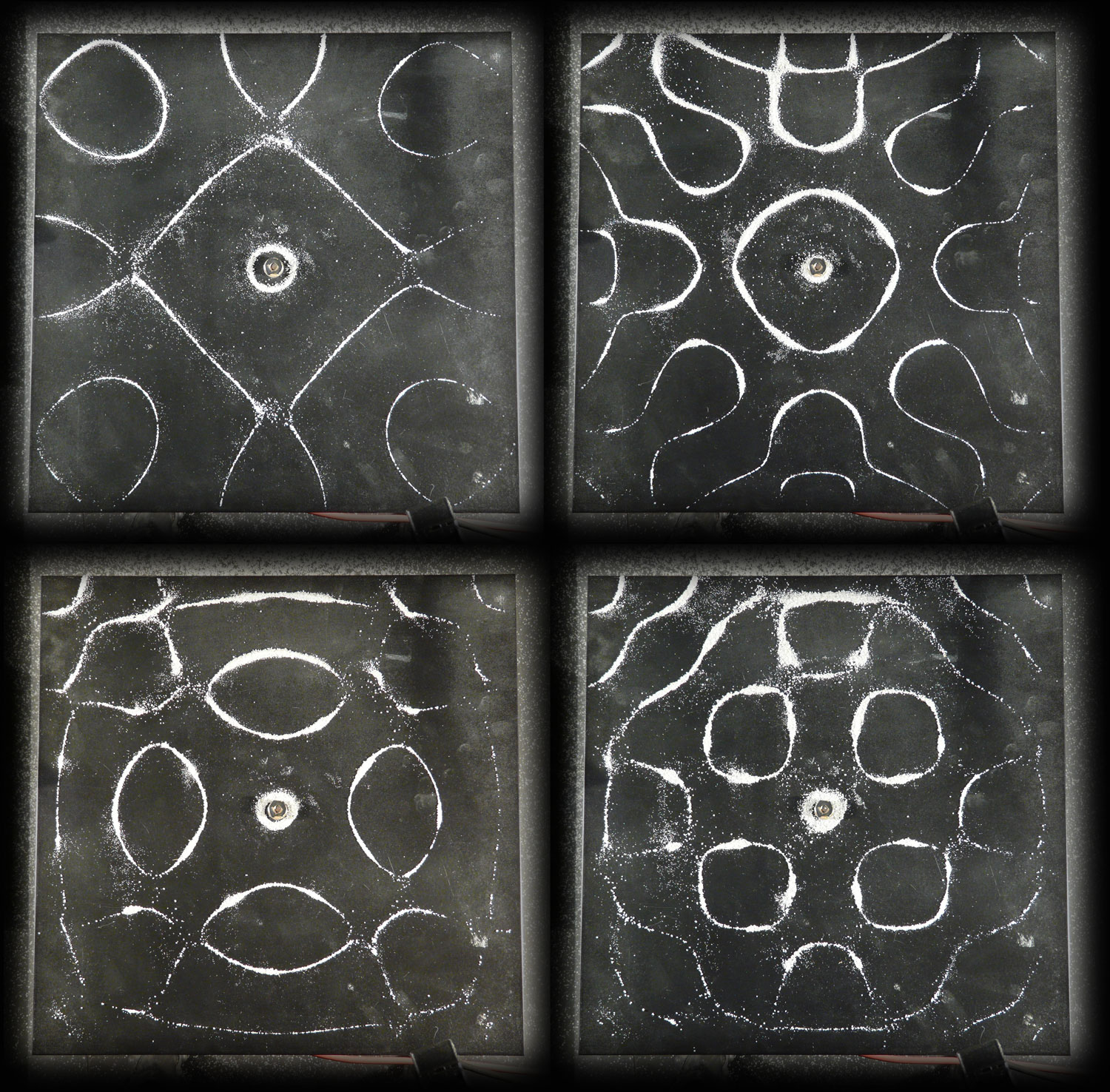
An extremely beautiful example of the phenomenon of stabilization upon
the repeating effect of a force on matter are the so-called Chladni patterns. They can be obtained by drawing a bow over a piece of metal whose surface is lightly covered
with sand. The plate is bowed until it reaches resonance, when the
vibration causes the sand to move and concentrate along the nodal lines
where the surface is still. Depending on the frequency of vibration, different patterns are obtained.
Here is a web link to a video on YouTube.
5. W. Somerset Maugham and the Meaning of Life
Interestingly enough, the view on the meaning life that appeals most to me is the one expressed in W. Somerset Maugham's novel
Of Human Bondage. Here is a
web link
to several excerpts from the book. Maugham's view draws obvious
parallels with the idea of beautiful patterns emerging as the result of
the evolution of matter. Maugham starts by observing that life has no
meaning:
"The answer was obvious. Life had no meaning. On the earth, satellite of a
star speeding through space, living things had arisen under the
influence of conditions which were part of the planet's history; and as
there had been a beginning of life upon it so, under the influence of
other conditions, there would be an end: man, no more significant than
other forms of life, had come not as the climax of creation but as a
physical reaction to the environment. [...] There was no meaning in life, and man by living served no end. It was
immaterial whether he was born or not born, whether he lived or ceased
to live. Life was insignificant and death without consequence."
Still, humans can give purpose to their lives by pursuing a rather aesthetic goal:
"As the weaver elaborated his pattern for no end but the pleasure of his
aesthetic sense, so might a man live his life, or if one was forced to
believe that his actions were outside his choosing, so might a man look
at his life, that it made a pattern. There was as little need to do this
as there was use. It was merely something he did for his own pleasure.
Out of the manifold events of his life, his deeds, his feelings, his
thoughts, he might make a design, regular, elaborate, complicated, or
beautiful; and though it might be no more than an illusion that he had
the power of selection, though it might be no more than a fantastic
legerdemain in which appearances were interwoven with moonbeams, that
did not matter: it seemed, and so to him it was. In the vast warp of
life (a river arising from no spring and flowing endlessly to no sea),
with the background to his fancies that there was no meaning and that
nothing was important, a man might get a personal satisfaction in
selecting the various strands that worked out the pattern. There was one
pattern, the most obvious, perfect, and beautiful, in which a man was
born, grew to manhood, married, produced children, toiled for his bread,
and died; but there were others, intricate and wonderful, in which
happiness did not enter and in which success was not attempted; and in
them might be discovered a more troubling grace."
6. The Sierpinski Triangle, Fractals and Fractal Music
Certain geametrical figures can be obtained by applying iteratively one
and the same construction, which stabilizes in the limit. Such figures
can thus be seen as the fixpoint of the iterative transformation. One
well-known construction is the Sierpinski triangle.
Here is a
web link to an animated version.
Fractals are typically
self-similar patterns, where self-similar means they are the same from near as from far.
Fractal music is one approach to compose music algorithmically, by applying the fractal principle of self-similarity. Here is a
web link to an article.